Discovery of the Central Sea
A Journey to the Centre of the EarthThe discovery of the Central Sea is the expedition’s revelation of a vast ocean beneath the Earth’s surface, a scene that overturns Henry’s suspicion that he has been carried back to the world above. The sea’s shore, weather, clouds, and tides resemble those of an open landscape, yet the granite vault overhead and the cold, unexplained light make this new world feel both magnificent and oppressive.
Awakening to an Unfamiliar Landscape
After an adventure spent in darkness, Henry wakes in a grotto whose floor is soft silvery sand and whose stalagmites glitter in rainbow colors. No torch or lamp is lit, but beams enter through an opening. The sound reaching him is equally disorienting: he hears a murmur like waves and what seems to be wind. Weak from his ordeal, he first wonders whether the fall has left him dreaming or whether Professor Hardwigg has abandoned the expedition and brought him back to the surface.
That uncertainty gives the discovery its first turn. Henry’s impressions of daylight, surf, and wind initially suggest a return to familiar conditions, but the explanation is not an ordinary sky or seashore. The sounds and light have come from a landscape deep underground. The scene moves from the vulnerability of a sick and bewildered explorer to the recognition that the expedition has reached a setting larger and stranger than the passages it has crossed.
Recognition of the Central Sea
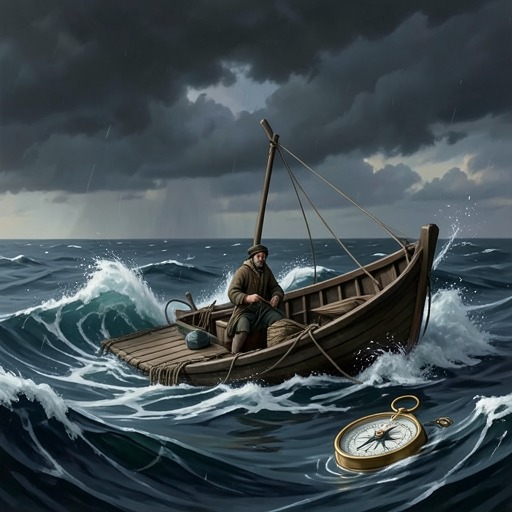
When Henry’s eyes adjust to the brightness, he sees an immense expanse of water stretching to the distance. His first response is to cry that it is the sea. Professor Hardwigg confirms the identification and claims the right to name the discovery, anticipating that future navigators will have to acknowledge it. The title Central Sea gives a name to what appears at first to be an endless lake and may, in scale, be an ocean.
The coast makes the underground setting legible through familiar details. A deeply indented shore of golden sand is scattered with small shells, remains of a long-deserted home for creatures of a past age. Waves break continually, sending spray into Henry’s face, while wind stirs the clear water. Capes, promontories, and immense cliffs line the margins; the cliffs have been worn by waves through countless ages. The view is not simply a hidden pool but a seascape whose scale and visible history make it feel ancient and open-ended.
Light and the Granite Roof
The sea is illuminated without sun, moon, or stars. Henry describes a trembling, dry, white light, slightly warm and stronger than moonlight, and infers that it is electric, comparable to the aurora borealis but constant enough to illuminate the whole cavern. This proposed explanation belongs to his attempt to make sense of what he sees: the light is vivid and extensive, but its source remains unlike any ordinary celestial body.
Above the water, moving nebulous vapors gather into dense clouds that partly conceal the cavern roof. Electric currents produce shifts of light and shadow, throwing deep darkness beneath the heavier clouds and occasionally letting an unusually intense ray break through. The illumination does not bring warmth like sunlight. Its beauty is therefore inseparable from unease: the scene has the changing brightness of weather, but its sky is a granite vault that seems to press down on the observer, not a blue firmament scattered with stars.
Shoreline, Streams, and Tides
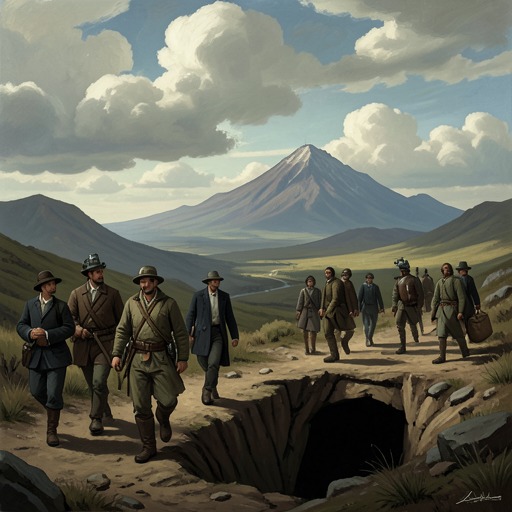
After breakfast, Professor Hardwigg takes Henry along the beach to study the tide at its height. The walk traces the landscape’s connection to the route that brought them there: abrupt rocks rise in a piled mass, and countless cascades descend their sides, becoming clear murmuring streams before flowing into the lake. Vapors rising from the rocks mark hot springs whose overflow also feeds the great reservoir. Among the streams Henry recognizes the Hansbach, their former companion, now apparently lost in the basin. His remark that they will miss it turns a geographical discovery into a quiet separation from a familiar guide.
Professor Hardwigg treats the tide as evidence that the underground sea remains subject to universal attraction. In response to Henry’s respectful doubt about whether the sun and moon could influence water below the surface, he argues that no body is exempt from the law of universal gravitation. Despite the great atmospheric pressure, he says, this inland sea rises and falls as regularly as the Atlantic. They reach the sandy shore as the waves are visibly rising, and Henry recognizes the incoming water as a flood. The observation joins the strange environment to a familiar natural rhythm: the explorers have entered a hidden world, but not one detached from the laws that govern the world above.
Significance in the Expedition
The Central Sea changes the terms of the expedition. Until this point, underground travel has meant a dangerous descent through confined passages; here, the route opens into water, weather, cliffs, and a horizon whose end cannot be seen. The explorers’ discovery is both an enlargement of their world and a challenge to their expectations: the apparent signs of daylight and surf do not indicate that Henry has escaped to the surface, but that a cavern can sustain a landscape resembling one.
The scene also holds wonder beside constraint. The golden strand, cascades, vapor, and electric play of cloudlight make the cavern astonishingly expansive, while the cold illumination and crushing granite ceiling deny it the freedom of an open sky. Professor Hardwigg’s naming of the sea and his attention to its tide turn spectacle into observation, but Henry’s perception preserves the discovery’s emotional cost. The Central Sea is a world to explore, not a return home.